Impact and Importance of Research Project Communication – from a Maritime Research Perspective

Abstract
Research communication is essential to the visibility, accessibility, and impact of maritime projects. This paper examines its definition, key tasks, evaluation metrics, benefits, and challenges, highlighting its role in translating complex technical knowledge for diverse stakeholders. It emphasizes the importance of structured communication and the inclusion of dedicated roles to improve outreach, ensure compliance, and enhance overall project success and long-term collaboration opportunities.
Definition of Research Communication
Research communication, also sometimes referred to as science communication, has undergone rapid expansion, placing increasing pressure on how its success is evaluated. This is partly due to the growth of digital media, which has significantly increased the number of communication channels available. These expanding channels have also broadened the target audience beyond fellow academics and project stakeholders. As a result, greater expectations have been placed on scientists and research institutions to engage in public communication about their findings (Volk & Schäfer, 2024).
In this context communication of research projects has become imperative to the visibility of project implementation and to the longevity of the project’s achievements. To dive further into the broader understanding of what research communication is, we must define the core goal of research communication. The definition of research communication is the process of disseminating research objectives, goals and achievements in a language that people who aren´t experts in the topic or field would understand (European Association of Development Research and Training Institutes, n.d.).
The tasks to fulfil this responsibility are dependent on the size and scope of the research project at hand. But the most basic tasks are:
- Communication strategy and planning
- Communication scheduling
- Event planning
- Dissemination and outreach
- Knowledge translation
- Visualization of findings
- Media management and networking
- Directing and initiating outputs
- Project site administration
- Social media administration
- Graphic design (flyers, web-based content, posters, logo)
- Informing research team of project funders regulations and guidelines
- Purchase of communication materials (flyers, roll-ups and merch)
The tasks are varied but, they are all tied to the dissemination and visibility of research projects. If the project is very large, there may be more tasks associated with strategizing, scheduling and media management. As larger projects take place over an extended period of time and have access to larger budgets, perhaps even with financial resources dedicated to communication allocated. They are also more likely to have a designated Research Communication Planner, Communication Manager or Research Communication Officer.
Some large research projects may opt for a different constellation, where the task of research communication also becomes the responsibility of the project leader, meaning that the project lead must take the above-mentioned demands and tasks into consideration – in addition to the tasks of leading the project and the people within it. Though this approach is more often the case for small to mid-sized projects.
The Benefits of Structured Research Communication
There are a multitude of benefits of having structured research communication managed by designated research communication staff, who have experience and knowledge of the responsibilities and tasks of research communication. The most visible benefit is that it improves visibility and outreach to the targeted demographic of the project, ensuring that those that are meant to hear and engage with the project are aware of it. This could be for policy makers, shipping companies, ports or end-users to name a few examples in the context of maritime projects.
Some projects may even have outreach tasks as their deliverable. In such instances, it is favorable to have a Research Communications Officer who can ensure that the deliverable is completed adequately, accurately and according to the guidelines of the funding party and the organizations involved. In this way ineffective communication styles are avoided, which is a clear benefit to the success of the project’s goals and objectives.
Excellent and dependable visibility increases the likelihood of heightened interest in research institutions and their capabilities. This, in turn, may attract new collaborators and invitations to participate in future projects. Consistent and professional outreach further establishes trust and public support for the institution (Zabrodskii, 2026).
Research Communication in Maritime Projects
Maritime projects have a wide range of field research, in topics such as logistics, sustainability and marine eco-system protection, resilience, supply chain, security, port management, and efficiency.
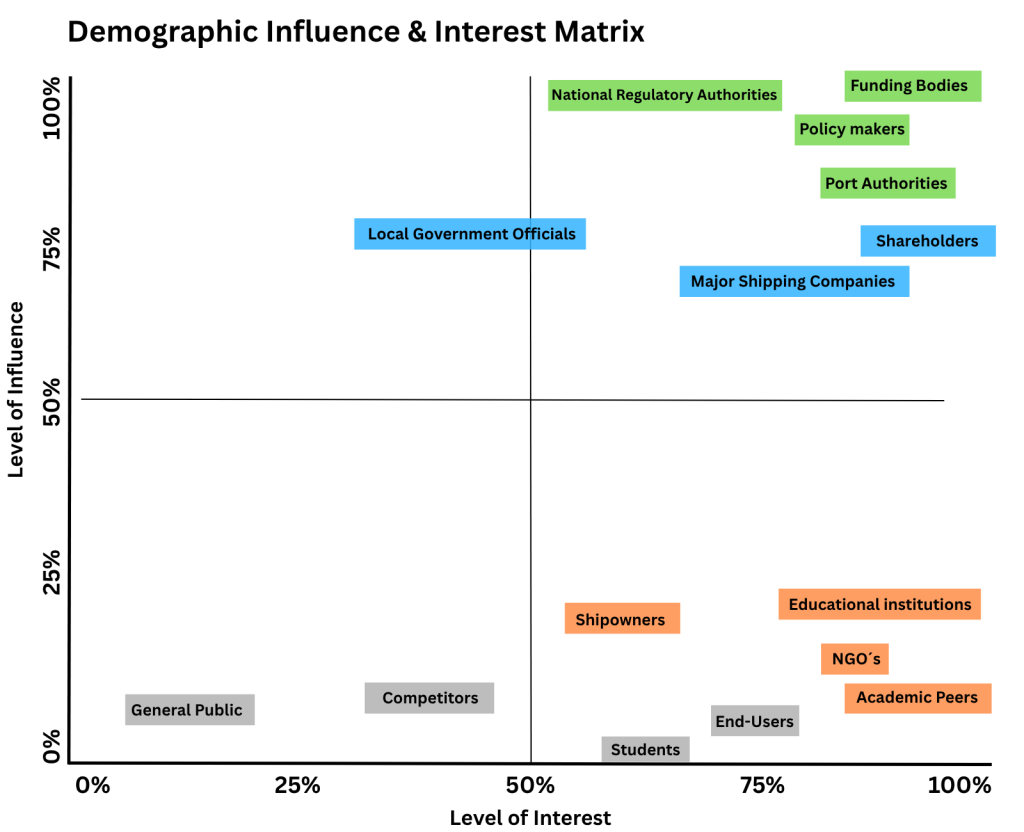
The different topics are associated with distinct demographic groups. These demographics are broadly divided into six main categories: Funding Bodies, Regulatory Authorities, Port Management, the Shipping Industry, End Users, and Educational Institutions. Each category comprises a group of entities with varying levels of interest in, and influence, the success of a general maritime research project. It is important to note, however, that depending on the research topic, these levels of interest and influence may differ substantially.
Figure 1 is a depiction of the demographic influence and interest matrix, as analyzed in a general context to maritime research. The horizontal axis measures the level of interest an entity has in the project, its findings, and actionable outcomes. The vertical axis measures their level of influence over the project in some capacity be it by outcome, financially or further visibility. It is noteworthy that certain stakeholders, including the general public who in the general analysis are shown to have very low interest and influence, may exhibit increased interest and influence when a project is highly controversial or establishes a precedent for future public discourse.
Funding bodies will always remain in a position of high interest and influence, as they often set guidelines while also serving as the financial backbone of the project. Governing and regulatory entities, however, will almost always have a high level of influence, although their level of interest may vary.
Maritime projects often involve high levels of technical expertise and address areas such as procedural changes, regulatory improvements, increased awareness, and mechanical or digital innovation. These topics require specialized knowledge that is not always communicated in a way that clearly conveys their practical impact on end users, students, or the general public. Therefore, research communication particularly in maritime projects is vital to ensure that those who may be affected by the research outcomes are aware of the project and its implications.
Evaluation and Impact Measurement of Research Communication
Proper and systematic evaluation of the effectiveness of research communication has not yet been fully utilized, according to Volk and Schäfer (2024), despite the existence of several available metrics for measuring the impact of communication activities. For example, when the output of research is a report, metrics such as download rates and citation counts can be used to assess its reach and influence. Additionally, the extent to which proposals or recommendations presented in the report are implemented by policymakers or adopted within industry practices can serve as an indicator of effective communication outcomes. Similarly, the success of digital journal articles can be evaluated through metrics such as clicks, read-through rates, and content sharing. Evaluation of research communication on social media platforms relies on metrics comparable to those used for digital publications, such as clicks and views, while also incorporating platform-specific indicators including reach and engagement (Trunfio & Rossi, 2021).
While digital metrics provide immediate feedback on reach, the ultimate measure of success remains the tangible adoption of research findings by industry or policymakers, suggesting a need for a hybrid evaluation framework.
Challenges in Research Communication
The greatest challenge in research communication is insufficient inclusion of communication staff in updates on the project’s progress, as they may identify information that is valuable to communicate, which experts and researchers may not recognize as worth disseminating. The tendency to overlook the importance of communicating the research process and its achievements is a significant mistake, as the project may ultimately remain unrecognized.
Conclusion
The benefits of proper and structured research communication are numerous. They extend beyond the immediate project being disseminated, supporting the development of new partnerships and future projects, and thereby ensuring growth in expertise and opportunities for research institutions. Involving a professional with experience in research communication within projects helps ensure the quality, structure, and effectiveness of dissemination.
Without structured research communication, even technically successful projects risk failing to achieve real-world impact. Therefore, it is advisable to consider communication as an integral part of project progress and achievements, as it reflects positively on both the project and the consortium involved. Furthermore, integrating robust evaluation frameworks alongside communication strategies ensures that the impact of these efforts is not only visible but also measurable and actionable. This can be further enhanced by incorporating communication strategies and goals into the application process, thereby making dissemination an integral part of the project from the outset.
Mona Molin Elo
Researcher, 0009-0001-8731-6416, Maritime Logistics Research Center
Mona M. Elo is a researcher with experience in research communication, in both large and small project structures.