International Cooperation Strengthens Maritime Logistics Expertise: The Case of Satakunta University of Applied Sciences and Jade University of Applied Sciences
Abstract
International university partnerships have become a central mechanism for developing maritime expertise in a rapidly evolving operational environment. This article examines the emerging cooperation between the Maritime Logistics Research Center of Satakunta University of Applied Sciences (SAMK) in Finland and the Faculty of Maritime and Logistics Studies at Jade University of Applied Sciences in Germany. The partnership encompasses educational collaboration, including Erasmus+ mobility and joint study modules, as well as applied research addressing maritime safety, cargo logistics optimization, and digitalization. A multi-stakeholder approach involving industry partners and regulatory authorities reinforces the practical relevance of joint projects, while shared simulation resources and benchmarking support the development of innovative training methods. This cooperation demonstrates that cross-border partnerships between universities of applied sciences can offer a practical and transferable model for tackling the shared challenges of contemporary maritime logistics.
Keywords: maritime logistics, international university cooperation, applied sciences partnership
Introduction
International cooperation between universities of applied sciences has become an increasingly important mechanism for advancing both the quality and relevance of higher education. Within the European Higher education area, such partnerships serve as platforms for exchanging expertise, developing joint curricula, and generating research with tangible societal impact (European University Association (EUA), 2022). In the maritime sector specifically, where the rapid pace of digitalization and regulatory frameworks demand continuous competence renewal, cross border institutional collaboration provides a particularly powerful means of bridging academic knowledge with industry realities (Demirel & Ziarati, 2011). The Erasmus+ programme has further formalized these partnerships by enabling structures mobility of student and staff, joint project development, and transnational knowledge transfer between European higher education institutions (Finnish National Agency for Education, 2025).
Based on this, the Satakunta University of applied sciences (SAMK), through its Maritime Logistics Research Center in Rauma, Finland, and JADE University of Applied Sciences (JADE Hochschule), through its Faculty of Maritime and Logistics Studies in Elsfleth, Germany, have initiated a multidimensional collaboration aimed at strengthening maritime expertise across both countries. JADE University’s faculty of Maritime Studies traces its origins to1832 and today stands as one of the largest maritime faculties of its kind in Europe. SAMK’s Maritime Logistics Research Center complements this profile with strong focus on Baltic Sea Logistics, Cargo optimization, and maritime safety research. Together, the two institutions represent a strategically well-matched partnership, one rooted in the complementary maritime geographies of the North Sea and the Baltic Sea, and united by a shared commitment to applied research and industry-relevant education.
Forms of cooperation
At the core of the partnership is educational collaboration, which enables mobility for students, researchers, and teaching staff, as well as the development of shared learning content. Erasmus+ exchange in particular offers structured opportunities for researchers and educators to support the transfer of knowledge and best practices between the two organizations (Finnish National Agency for Education, 2025). The collaboration is further reflected in joint lectures, expert visits, and participation in professional events such as maritime network days. Joint study modules and courses can additionally be developed, enhancing students' international competencies and bringing the latest research directly into teaching practice. In the longer term, this may include modular, international study programs that support lifelong learning and respond to the evolving competence needs of the maritime sector.
Cooperation between the institutions' simulation centers offers a particularly concrete avenue for deepening practical expertise. Comparing training environments, and potentially sharing them, can support the development of more realistic learning settings for vessel operations, risk management, and preparedness for disruptions and crisis situations. Benchmarking plays an equally important role across the partnership more broadly: comparing operational practices and organizational structures provides valuable insight into how maritime education and research are organized in different national contexts, and where improvements can be made.
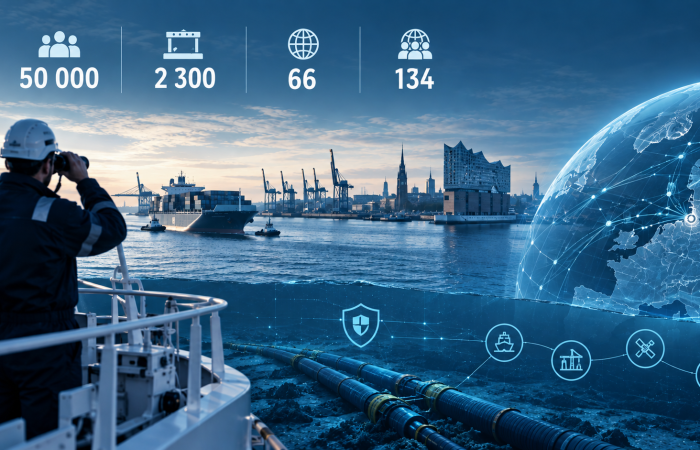
A promising area for future cooperation is the development of joint research and innovation projects related to maritime logistics and maritime safety in the Baltic Sea region. By combining SAMK’s experience in the Baltic Sea logistics, security of supply, and maritime safety with Jade University’s expertise in maritime and logistics research, the partnership creates opportunities to address shared challenges facing the sector. Potential research topics include the resilience of maritime transport routes, port logistics efficiency, and maritime traffic management. The partnership may also explore emerging technologies related to smart and autonomous shipping. Special interest can be found in the areas of strengthening safety and situational awareness in the Baltic Sea region. This is particularly important as the area sees a growing traffic volume, environmental concerns, and changing geopolitical environment. Through mutual and shared research, some pilot activities, and close cooperation with industry, the two institutions aim to support the development of safer, more sustainable, and more efficient maritime operations across Northen Europe.
Research and Development Agenda
Research collaboration forms a central part of the partnership. Joint projects focus on current maritime themes including maritime safety, cargo routing and logistics optimization, and the digitalization of maritime operations. The cooperation is designed to be broad and inclusive, involving companies in maritime data projects and engaging regulatory authorities in the development of safety solutions. This multi-stakeholder approach helps ensure that research results are effectively translated into practice and increases the overall societal impact of the work.
The differing maritime environments of the two partner regions add further research value. The Baltic Sea and the North Sea each present distinct operational conditions, offering complementary settings for testing and validating new solutions under varying circumstances. By combining research expertise and datasets across these regions, the partnership creates opportunities to develop digital tools for cargo optimization and maritime traffic forecasting that are robust across diverse contexts.
Joint project development and proposal writing open new pathways to international funding, including European Union programs. This strengthens both institutions' capacity to address large-scale research and development challenges that neither could tackle as effectively alone. At the same time, the expanded network of companies, authorities, and research institutions across Europe accelerates the translation of innovations into practice.
Conclusion
The cooperation between SAMK Maritime Logistics Research Center and Jade University of Applied Sciences represents a purposeful response to the growing complexity of maritime logistics in Europe. As this article has outlined, the partnership brings together educational exchange, applied research, simulation-based training, and joint project development into a coherent and mutually reinforcing framework.
What makes this collaboration particularly significant is its embeddedness in real operational contexts: the distinct maritime environments of the Baltic Sea and the North Sea provide not merely symbolic common ground, but a genuine basis for comparative and transferable research. Combined with European funding structures such as Erasmus+ and Horizon programmes, the partnership is well positioned to scale its impact beyond the two institutions.
More broadly, the cooperation between SAMK and Jade University demonstrates that universities of applied sciences are well placed to address complex sectoral challenges when they commit to sustained, strategically aligned international collaboration. The resulting benefits extend well beyond the academic sphere, encompassing industry operators, regulatory bodies, and the maritime ecosystem across Northern Europe.
A promising area for future cooperation is maritime safety and situational awareness in the Baltic Sea region. The Baltic Sea is facing a range of challenges, including increasing vessel traffic, environmental pressures, and a changing security environment, all of which highlight the need for new knowledge and practical solutions. By bringing together expertise from both the Baltic Sea and North Sea regions, SAMK and Jade University have an opportunity to contribute to the development of improved methods, digital tools, and operational practices that support safe and resilient maritime operations. Although the specific focus of future projects has yet to be determined, maritime safety provides a natural foundation for further collaboration and offers clear benefits for both researchers and maritime stakeholders.
Katri-Piia Rajala
Head of Research, 0009-0006-7174-0905, Maritime Logistics Research Center
Rajala is Head of the SAMK Maritime Logistics Research Center and Head of the Rauma Maritime Training Center (Maritime Continuing Education, SAMK).
Miiko Y. Laine
Researcher, 0009-0006-2235-3271, Maritime Logistics Research Center
Laine (M.A. in Social Sciences), works as a Project Manager at the Maritime Logistics Research Center of Satakunta University of Applied Sciences (SAMK), where his responsibilities focus on security of supply and maritime safety. He currently leads the NEMO CEF project and contributes to several other ongoing research and development projects.