Developing the Net Zero Port Guide: A Framework for Actionable Decarbonization Strategies in Maritime Logistics
Abstract
Sustainable port operations face complex environmental challenges, balancing emissions reduction with economic and operational pressures. Generic sustainability reports often fail to address unique logistical constraints, leaving port authorities without actionable strategies. This article introduces the Net Zero Port Guide, a strategic resource designed to bridge this gap by providing practical insights into energy efficiency and renewable energy adoption. Developed through a structured methodology, the tool synthesizes best practices from pilot ports into an accessible wiki format. It addresses critical barriers such as financial constraints, regulatory uncertainty, and technical complexities by highlighting long-term cost benefits and compliance pathways. The Guide demonstrates that decarbonization and the flow of goods are interconnected, offering a roadmap for ports to optimize energy use without compromising efficiency. By empowering decision-makers with verified case studies and strategic insights, the Net Zero Port Guide facilitates a collaborative shift toward greener, more resilient maritime operations.
The Challenge
Sustainable port operations face complex environmental challenges, as ports are major hubs of global trade and logistics activity (OECD, 2014). Emissions from ships, cargo-handling equipment, and associated land transport are significant contributors to air and water pollution. These emissions include greenhouse gases and particulate matter. Addressing these issues requires ports to adopt cleaner technologies and renewable energy systems, but implementation of such measures may be challenging due to the scale of operations and logistics infrastructure.
Ports must simultaneously balance environmental goals with economic and operational expectations and pressures (Notteboom et al., 2014). Transitioning to more sustainable practices, such as electrification, alternative fuels, and digital monitoring systems, demands significant investment and long-term planning, while ensuring alignment with sometimes uncertain regulatory frameworks and rapidly evolving technologies. Coordination among stakeholders, including port authorities, shipping companies, and governments, adds further complexity, as sustainable solutions often depend on collective action. Ports must also remain competitive and efficient while adapting these solutions. These overlapping demands make achieving sustainability in port operations a technical, strategic, and organizational challenge.
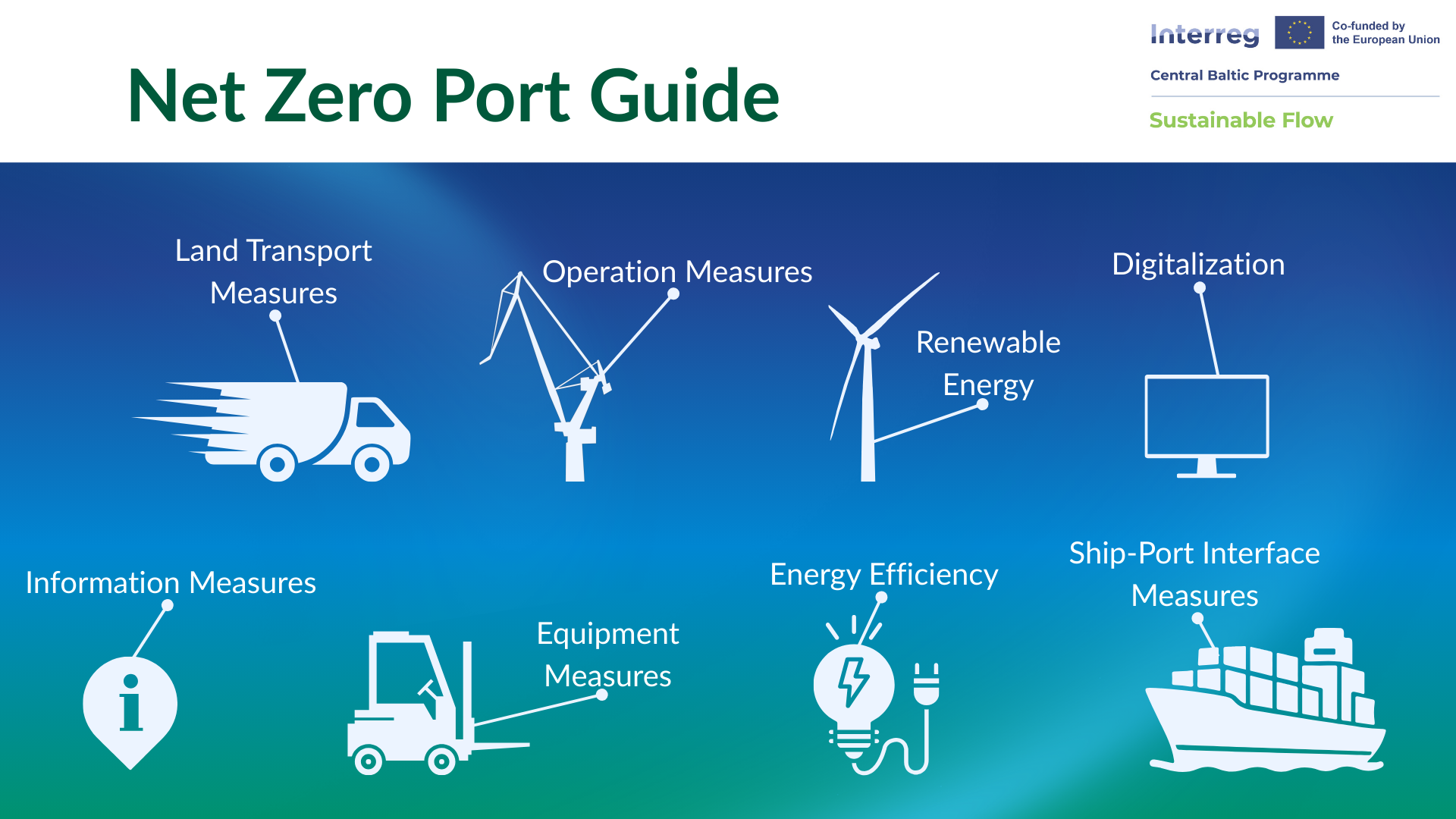
It is this complexity that the Net Zero Port Guide aims to resolve. By consolidating best practices and actionable strategies into a single, accessible resource, the guide acts as a roadmap, enabling ports to navigate the transition to decarbonization.
The Practical Impact The significance of the Net Zero Port Guide is its ability to meet local infrastructure and requirements. Currently, there is a reliance on generic sustainability reports, which fail to account for unique logistical constraints of individual ports. A port in the Baltic Sea has different challenges than one located in the Mediterranean or the Pacific (OECD, 2014).
There is a fundamental need for a more localized understanding of how to implement solar integration on warehouse rooftops, for example, how to improve management systems or energy saving, or how to refine fuel-saving measures in high- or low-traffic logistic zones. The Net Zero Port Guide was developed to answer the "why" and "how" by providing practical case examples from real ports around the Baltic Sea. These examples prove that greener operations are viable across diverse port infrastructures.
The Practical Impact
The significance of the Net Zero Port Guide is its ability to meet local infrastructure and requirements. Currently there is a reliance on generic sustainability reports, which fail to account for unique logistical constraints of individual ports. A port in the Baltic Sea has different challenges than one located in the Mediterranean or the pacific (OECD, 2014).
There is a fundamental need for a more localized understanding of how to implement solar integration on warehouse rooftops, for example, how to improve management systems or energy saving or how to refine fuel-saving measures in high- or low- traffic logistic zones. The Net Zero Port Guide was developed to answer the 'why' and 'how' by providing practical case examples from real ports around the Baltic Sea. These examples prove that greener operations are viable across diverse port infrastructures.
The Concept
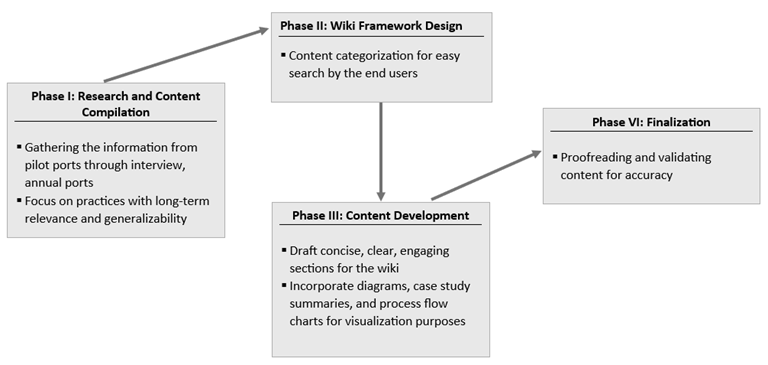
The development of the Net Zero Port Guide followed a four-phase methodology which was designed to ensure the relevance, accuracy, and usability of the tool.
The first phase, called Research and Content Compilation, focused on gathering reliable data and transferable information from pilot ports and maritime organizations. The emphasis was on identifying energy efficiency, renewable energy, and storage of energy supplies. Sources also included best practices and lessons learned from real-world implementations.
The second phase involved the design of the Net Zero Port Guide framework, which was developed as an open-access tool as a ThingLink page. The format is that of a wiki page, with well-organized categories making it easy to research specific topics the end-user desires. The visual framework is designed to be intuitive, guiding the users from general concepts to more specific and actionable strategies.
The third phase was that of content development, which involved drafting the text and content for the tool. The texts were crafted to be concise, clear, and accessible. The sections were made with the goal of providing actionable insights and practical guidance, while ensuring that the information is easily understood and applied.
The fourth and final phase was ensuring the usability of the tool for the end-user. The content was proofread thoroughly for validation, accuracy, and relevance. The entirety of the process ensures that the outcome meets the actual needs of the industry.
Cost, Regulation, and Technology
Despite the benefits of adopting new energy solutions in ports, there are challenges such as financial constraints, regulatory uncertainty, and technical complexities.
The financial barriers are often the most apparent, as ports may hesitate to invest in renewable energy due to high costs. The Net Zero Port Guide addresses this by highlighting the long-term financial benefits, such as reduced electricity bills and improved operational performance. It also points to potential funding opportunities and incentives that can help offset the initial investment.
Alignment of Strategies
A key benefit of the Net Zero Port Guide is an enhanced understanding of energy use and emission sources in port operations. This insight helps ports align their strategies with customer demands, while also addressing sustainability requirements. The tool encourages greater collaboration between ports, creating synergies that amplify efforts to reduce emissions and drive the industry toward more sustainable practices.
A key benefit of the Net Zero Port Guide is an enhanced understanding of energy use and emission sources in port operations. This insight helps ports align their strategies with customer demands, while also addressing sustainability requirements. The tool encourages greater collaboration between ports, creating synergies that amplify efforts to reduce emissions and drive the industry toward more sustainable practices.
Conclusion
The Net Zero Port Guide represents a digital resource that can contribute to a shift in how the maritime industry approaches sustainable port operations. It encourages decisive action towards decarbonization and sustainable efforts in a practical and achievable way. Successful green transitions require not just technology, but reliable and strategic insight into how to deploy the actions and tools effectively within complex logistical and industrial port systems.
The Net Zero Port Guide demonstrates that the flow of goods and environmental stewardship are not mutually exclusive. In fact, they are deeply interconnected. Efficient energy use leads to cost savings, which can be reinvested in further sustainability initiatives. Cleaner operations improve the reputation of ports, attracting environmentally conscious customers and partners.
Mona Molin Elo
Researcher, 0009-0001-8731-6416, Maritime Logistics Research Center
Mona M. Elo is a researcher, who has worked with the development, building and graphic design of the Net Zero Port Guide.

This article was written as part of the Sustainable Flow Project, which is funded by the Interreg Central Baltic Programme. The project is developing digital solutions to boost energy saving measures and implementation of renewable energy in port operations in the Central Baltic Region.